#DPTSTUDENT CHAT TOPIC FOR WEDNESDAY, NOVEMBER 13, 2013: APTA SECTION SPOTLIGHT! PRIVATE PRACTICE SECTION

One of the benefits of being an active member of the APTA includes opportunities to explore the 18 sections and specialties. Acting upon opportunities to gain insight and mentorship from these sections is of vital importance to us now, as students as we are developing and deciding on what type of clinicians we hope to be in the rapidly approaching future. How many of us know what being a member of a section means? What benefits may come from membership and what value does being a member place on our future as a clinician? What resources can these sections provide to its members and what networking and continuing education do they offer? The people that bring you the #DPTstudent chat each week have recognized these frequently asked questions and have gone straight to the source(s)! We are joined this week by active Private Practice Section (@pps_apta) members Jerry Durham (@Jerry_DurhamPT) and Robert Snow (@RobertSnowDPT), who will be offering us insight into benefits of being a member of the Private Practice Section. This will include mentorship opportunities, practice-building resources, networking opportunities etc. Mark your calendars for this Wednesday at 9pm EST, you won’t want to miss it!


Blog post written by TJ Janicky (@TJ_Janicky)

Agree to Disagree the Less Wrong Way


No, you’re not entitled to your opinion
. Well, so says lecturer in philosophy Patrick Stokes

I’m sure you’ve heard the expression ‘everyone is entitled to their opinion.’ Perhaps you’ve even said it yourself, maybe to head off an argument or bring one to a close. Well, as soon as you walk into this room, it’s no longer true. You are not entitled to your opinion. You are only entitled to what you can argue for.”

A bit harsh? Perhaps, but philosophy teachers owe it to our students to teach them how to construct and defend an argument – and to recognize when a belief has become indefensible.

Usually, agreeing to disagree ends a discussion. But, agreeing to disagree in order to facilitate true debate should actually initiate the discussion. Attack the message, not the messenger. It’s not personal.

And, that’s the point. Rigorously critiquing the message, ideas, and reasoning is not insulting the person. It’s the foundation of the evolution of the scientific process after new data or theories emerge. Heated, passionate debate can (and I would argue should) be followed by laughter and delicious beverages amongst colleagues (and even rivals!). These fiercely disagreeing colleagues can even be friends.

You are safe, but your ideas are not

But, we are dealing with humans. Humans with complex emotions, previous experience, and beliefs. Brains that are prone to cognitive biases and logical fallacies, even when explicitly on the lookout for them. We are a messy, social, complicated, emotional bunch. The online experience evolved to Web 2.0 “the collaborative internet” (now even Web 3.0) resulting in the proliferation of two way communication and information exchange on the web. The user is actively involved in collaboration and user generated content. Interaction with both content and people has become an integral, regular facet of the online experience. Blogs, blog comment sections, Facebook, and micro-blogging platforms such as Twitter are a routine part of our social as well as professional lives.

So, how can we foster real debate and discourse that is focused on the issues? It’s simple (kind of, in theory), but it’s not easy. Philosophically, absolute truth is a hard, if not impossible, concept (wikipedia truth). In discussions regarding both science and clinical care, the aim is not to be right (per se). But, rather, to approach a state of less wrong. Such a concept recognizes the evolving nature of our understanding in light of new evidence and insight. The goal thus becomes a proper analysis of the position or conclusion presented including the evidence (from basic science to outcomes studies) but also the logic, reasoning, and prior plausibility supporting or refuting the stated position. This approach applies to online discussion, article analyses, professional discussion, and education at all levels. The disagreement hierarchy outlines the strength, and relative validity, of a counterargument. It provides a formal guide for framing discussions.
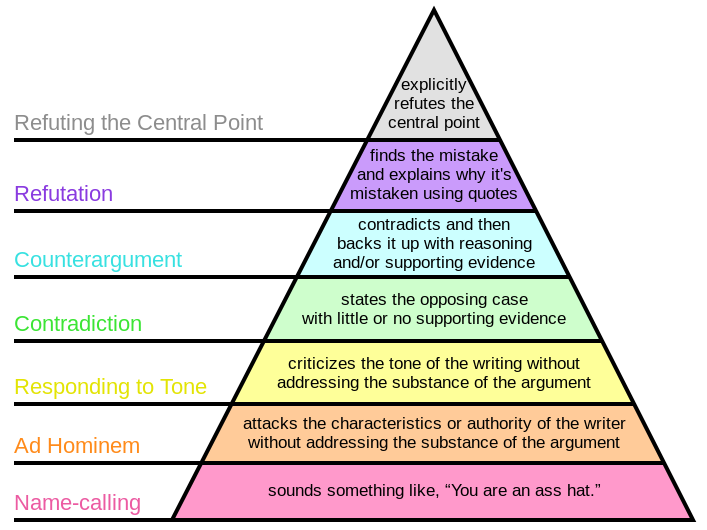
 

Graham's Hierarchy of Disagreement


Why is all of this important?

The online disinhibition effect describes how interactions online may actually be more prone to errors in disagreement and discussion. Whether on blogs, Facebook, or Twitter  endless examples of poor debate are present. Ad homineum attacks (you have no experience in this), complaints of tone (you’re so negative), and down right insults (you’re an idiot). Gross illustrations of both logical fallacy and bias (we’ve all got it, except for me of course).

Sometimes, the lower levels of the disagreement hierarchy are actually true. An ad hominem argument highlighting an individuals lack of expertise, knowledge, or experience may be factually accurate. But, while true in and of itself, it does not necessarily invalidate or refute or counter argue the position presented. For example, a cranio-sacral therapist may argue that I have “no experience” performing cranio-sacral therapy. While true, that does not address my position that cranio-sacral therapy’s explanatory model is indefensible, regardless of the perceived or studied effectiveness of the treatment. Thus, even if it works, it does not work as theoretical presented. And, that is vitally important, and often missed construct, when discussing clinical care. Mary Derrick, @Mary_PT2013, previously addressed the use of clinical reasoning and critical thinking from a DPT student’s perspective.

Thinking, Fallacies, and Biases

Unfortunately, an understanding of the mechanics of debate and the basic fallacies of logic is not sufficient. In order to discuss effectively at a high level we also must possess critical thinking skills. We need to understand and recognize logical fallacies and cognitive biases. We need to understand the basic mechanics of science, mathematics, and statistics. We need to understand what certain studies can and can not tell us. We need to understand prior plausibility. We need to think about our thinking (metacognition).

Even more unfortunate is the lack of teaching students how to think. “Schools of thought” and “gurus” continue to dominate our profession as well as public discourse (see Dr. Oz and the muriad of health and fitness fads). Students, practitioners, and even researchers indoctrinated in evidence based practice volley outcomes based RCT’s attempting to illustrate their positions. Professionals argue with each other about tone, experience, and doing “whatever works.” As Jason Silvernail, DPT, DSc observed in his post EBP, Deep Models, and Scientific Reasoning

When I see my colleagues approaching alt-med treatments asking for outcome evidence, I get justifiably nervous – are they just one RCT away from believing in energy medicine? What we should be focusing on is the absolutely indefensible theory here – it’s scientific reasoning that will help us here, not statistics. Let’s never forget that.

Specifically as the profession of physical therapy and more generally in science and public discourse the conversations needs to continue beyond “lets agree to disagree.”

Debate and arguments need to occur

There are beliefs, models, terms, and ideas that permeate our profession, the health care system, and culture that need abandoning. Can you think of any? Understanding the what and why of clinical care and scientific discussion from a Science Based Medicine perspective:

Good science is the best and only way to determine which treatments and products are truly safe and effective. That idea is already formalized in a movement known as evidence-based medicine (EBM). EBM is a vital and positive influence on the practice of medicine, but it has limitations and problems in practice: it often overemphasizes the value of evidence from clinical trials alone, with some unintended consequences, such as taxpayer dollars spent on “more research” of questionable value. The idea of SBM is not to compete with EBM, but a call to enhance it with a broader view: to answer the question “what works?” we must give more importance to our cumulative scientific knowledge from all relevant disciplines.

If only it ended there. What about that uncomfortable feeling? Defensiveness, feeling offended, stomach churning. These feelings and thoughts are a result of your mind, your brain struggling with two conflicting ideas or ideals. Cognitive Dissonance

In psychology, cognitive dissonance is the discomfort experienced when simultaneously holding two or more conflicting cognitions: ideas, beliefs, values or emotional reactions. In a state of dissonance, people may sometimes feel “disequilibrium”: frustration, hunger, dread, guilt, anger, embarrassment, anxiety, etc.

Some studies illustrate that when presented with evidence conflicting their current position or understanding, humans actually become more entrenched in that belief or view point. So, without a focus and understanding on these principles of debate, disagreement, logic, and fallacy discussion poses the potential to be detrimental. The debate disintegrating into personal attacks and emotional based offensive points as each person drifts deeper into their current view point. Each party fighting uncomfortable cognitive dissonance, and actually confirming previously held beliefs. Critical thinking and metacognition are needed. Patrick Stokes again summarizes:

The problem with “I’m entitled to my opinion” is that, all too often, it’s used to shelter beliefs that should have been abandoned. It becomes shorthand for “I can say or think whatever I like” – and by extension, continuing to argue is somehow disrespectful. And this attitude feeds, I suggest, into the false equivalence between experts and non-experts that is an increasingly pernicious feature of our public discourse.

So, please, let’s agree to disagree.

#DPTSTUDENT CHAT TOPIC FOR WEDNESDAY, NOVEMBER 6, 2013: METACOGNITION OF THE DPT STUDENT

Every DPT program is designed to prepare us for boards and make us capable general practitioners. That typically involves cramming massive amounts of anatomy, physiology, pathology, etc. into our brains. One thing that DPT school and most school as a whole doesn’t teach is how to think.
The subject of metacognition or thinking about our thinking has become somewhat of a hot topic in the PT world. We are privileged to have Dr. Kyle Ridgeway, DPT on to co-host this weeks chat on learning how to think and the importance of metacognition.
Kyle is a physical therapist who has written and put much time into the subject. Join us 9 PM EST to discuss with Kyle and get resources to grow as a future DPT.
Blog post written by Zach Duhamel (@zduhammy)

#DPTSTUDENT CHAT FOR WEDNESDAY, OCTOBER 30, 2013: PROFESSIONAL DEVELOPMENT WITH A GUEST TWEETER!

Professional development is an important aspect of both our education as a student and our growth as a professional. In August 2003, Professionalism in Physical Therapy: Core Values was reviewed by the APTA Board of Directors and adopted as a core document on professionalism in physical therapy practice, education, and research. Included in these core values was a definition of “Professional Duty” defined as commitment to meeting one’s obligations to provide effective physical therapy services…to serve the profession and to positively influence the health of society. Indicators of this core value in practice include, promoting the profession of physical therapy, being involved in professional activities beyond the practice setting and in my opinion the most important indicator, taking pride in ones profession.

Joining us this Wednesday at 9pm EST, on the topic of  “Professional Development” is @WebPT co-founder and COO, Heidi Jannenga (@HeidiJannenga). Heidi is a practicing physical therapist as well as huge demonstrator of #PTAdvocacy.


Blog post written by TJ Janicky (@TJ_Janicky)

#DPTSTUDENT CHAT TOPIC FOR WEDNESDAY, OCTOBER 23, 2013: INDEPENDENT LEARNING OUTSIDE OF THE CLASSROOM

Let’s face it- there is no way to learn everything possible in PT school. We are taught how to be competent entry level physical therapists. However, I want to be more than just competent so I do some of my own independent learning especially on topics I am interested in or find especially challenging. While free time is tight in PT school (you know we all spend most of our Friday nights in pajamas with our nose in a study guide. I really hope it’s not just me!) I thin it is important to stay up to date with current PT events and expand your knowledge.

What do you think? How do you learn outside of PT school? Let’s talk about it Wednesday night at 9pm EST!

#DPTSTUDENT CHAT TOPIC FOR WEDNESDAY, OCTOBER 16, 2013: AAOMPT AND MANUAL THERAPY!

This week we are privileged to have Eric Robertson join the #dptstudent discussion on the upcoming American Academy of Orthopaedic Manual Physical Therapy (AAOMPT) Conference and manual therapy as a whole. The AAOMPT is a leader in training and promoting manual therapy in the US for over 20 years. For more on their history check here .

Eric Robertson is a fellow of the AAOMPT as well as a well known national advocate and leader in the field of physical therapy…and owner of this blog! Come join the conversation to learn all about the AAOMPT, manual therapy, fellowships, and a whole lot more.

For more information and to stay up to date with AAOMPT check out their new blog http://blog.aaompt.org/

See you at 9pm EST on Wednesday October 16!


Post written by Zach Duhamel (@zduhammy). Chat will be hosted by Lauren Kealy (@laurenrspt) and TJ Janicky (@TJ_Janicky) 

#DPTSTUDENT TOPIC FOR WEDNESDAY, OCTOBER 9, 2013: BUILDING YOUR ONLINE BRAND/ VISIBILITY IN PREPARATION FOR A JOB

Therapydia (@therapydia) is an online networking site for patients and PTs alike to find each other. They take physical therapy and put it totally online so that PTs have a greater reach to patients and that patients are able to research their condition, ask a PT and then find a PT in their area.

This Wednesday, Therapydia will be talking with us about how to build your online brand and visibility and how it can help us students find jobs and build referral sources. In this day and age, with the power of social media, it is not uncommon that job connections are made via social media and having a strong online brand BEFORE trying to find a job could making landing that dream job a bit easier. Join us on Wednesday, Oct 9th at pm EST for what is sure to be a fantastic chat!

#DPTSTUDENT CHAT TOPIC FOR WEDNESDAY, OCTOBER 2, 2013: HOW THE HEALTH CARE REFORM EFFECTS PT

As students we are emerging from school at a pivotal point in health care. We are walking into some big changes that will have profound effects on both our patients and us as physical therapists. So what should we expect? According to the Kaiser health tracking poll in September of 2013, 51% of the population felt they did not have enough information about the law to understand how it will impact their families. Our patients will be asking us the big questions about these confusing health care changes, which is why we should be preparing now! Questions we as PT students should be asking are: how will the health care reform improve the health care system? What types of coverage and benefits can we expect for our patients? Finally, how will health care reform impact my practice and ability to provide quality care?

Join us at 9 p.m. EST , as we are joined by Dr. Kathy Mairella (@kathymairella), covering the topic of health care reform. Dr. Mairella currently serves as Director on the APTA BoD. Dr. Mairella is a full-time faculty member at Rutgers University where she teaches Health Care Delivery Systems as well as Professional Development. Finally, Dr. Mairella was the former President of the NJ chapter of the APTA.


Blog post written by TJ Janicky (@TJ_Janicky)

#DPTSTUDENT CHAT TOPIC FOR WEDNESDAY, SEPTEMBER 25, 2013: HOW CAN PTS CONSTRUCTIVELY HELP PEOPLE STAY INJURY FREE WHEN PARTICIPATING IN FAD WORKOUTS?

Crossfit. Pure Barre. P90X. Hot Yoga. TRX. Insanity- just to name a few of the hottest fad workouts people are participating in. They have many things in common such as having the power to get people excited to work out but they also all come with their own risks and set of potential injures. Who do we, as future physical therapists, keep the newbie or advanced participant from pushing themselves so hard and leading to injury? Is there a way to educate those participants before they end up in our clinic or is that stepping on the toes of the coaches who teach these classes?

Please note that this chat is not intended for us to bash these workouts but to discuss how we can help educate those who may push themselves too far. See ya Wednesday!


#DPTSTUDENT CHAT TOPIC FOR WEDNESDAY, SEPTEMBER 11, 2013: OWNING YOUR OWN CLINIC

I think many #DPTstudents think about what it takes to open up and manage a successful PT clinic. I dream of opening my own place but I have a ton of questions from finances, to insurance, staffing, balancing family life and so much more. Several clinic owners are willing to answer all of our questions on this topic this Wednesday.

Hope you can join us on Wednesday at 9pm EST!