
The Many Faces of the Electronic Medical Record

Healthconsumerinthecenter

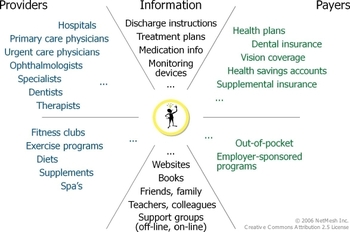
The electronic medical record can mean different things to different people.  To Microsoft and Google among other Health 2.0 companies, it is a future of their business.  To patients, it is concern over privacy and hope for improved care continuity.  For medical providers it is an enormous added expense and a headache of technical details to do a job they are already performing. 

But, the electronic medical record could also be a way to do business differently, to become more efficient.  To do the job better.  A couple things are certain: as health reform progresses the electronic record will prevail, and that it might not be so smooth.  Just yesterday I read a news piece where electronic claims filing made it easier for Wal-Mart to recoup money paid in an injury settlement, effectively taking one woman’s health-trust and leaving her dependent upon the government for her care.  Is this what we had intended when we first thought of the electronic records?

Radiology as a Benefit to Physical Therapist Practice

My personal experience with electronic medical records is with the military health system.  It was sometimes slow and tedious, but it was incredibly useful all of the time.  In fact, I have a hard time imaging practicing without an integrated medical record in front of me at this point. 

Perhaps the most useful aspect of the military’s electronic system, which contrasts most significantly from usual physical therapist practice, concerns radiology reports.  Forget for a moment the benefit that military physical therapists have in ordering radiographs (yes, they can order all types of radiographic imaging and may do so as effectively as orthopaedic surgeons) , and just consider the benefit of reading reports and viewing the radiographs themselves.  I think this calls for a list:

1.  Reduced guess work when patient history is unclear

2.  A greater understanding of each patients pathology

3.  Patient education opportunities are enhanced in front of their radiographs

4.  Observation of what studies have been performed provide insight into thinking and problem solving of other providers

5.  Improved prognosis decisions

The radiographic benefit is but one example.  The overall message is that despite the many different particulars of the electronic medical record, it is somewhere we are heading.  Careful consideration of the pitfalls and benefits of the process will ensure the efficient, timely transition. 

ERIC

Giving Thanks & A Holiday Wish List

First_snow

It’s the holiday season and the time is ripe for a holiday-related post!  Thanksgiving is a time to give thanks, so what do physical therapists have to give thanks for this year?  How about:

1.  Bountiful clinical research productivity

2.  The DPT transition in educational programs and rapid adoption of the tDPT degree

3.  The APTA’s new CEO

4.  Growing numbers of Residency and Fellowship programs

5.  Podcasts, videos, and re-designs offered by our journals; and blog readership and writing, as more PT’s exchange information via the collaborative web.

Whatever your celebratory affiliation is, gifts such as these corporate hampers aare somehow involved in December; and the season is upon us. One great tool for organizing gift ideas is Shoppok’s wishlist feature, which can be particularly handy for professionals. What are some things that might fall on physical therapists’ wish lists? Here is mine:

1.  Not just autonomous practice, but true ownership of our profession through phasing out of referral-for-profit arrangements.

2.  License to utilize radiological imaging in clinical practice.

3.  A profession-wide, rapid shift to a clinical education model that more closely resembles the medical model.

4.  Abolition of the CAP.

5.  Freedom from legislative assault

Leave some comments about what you might be thankful for…or are hoping for as the new year approaches!

Happy Holidays!

ERIC

image by Robert Lynn

Physical Therapists or Stealth Medicine?

For those of you who are not power blog readers, I may first need to introduce you to the Respectful Insolence blog, written by Orac.  It’s one of the best, so subscribe.

Orac has made mention again of over-zealous chiropractors, characterizing them as "physical therapists with delusions of grandeur who don’t know their limitations."  He, along with Panda Bear, MD, is quick to point out the gaping holes in the science behind the whole subluxation concept.  Yes, that’s the concept which forms the core of chiropractic medical care.  In this case, Panda Bear, MD is concerned about the new pediatric focus in chiropractic care:

"Would you take your child to a Physical Therapist for routine health maintenance, well child checks, or even something as serious as asthma? Of course not. And no Physical Therapist would touch your child in this capacity for the same reason I don’t perform abdominal surgery, namely that it is well outside of my training and my legitimate scope of practice."

Limitation, problems with subluxation science…seems like something I’ve heard before.  Indeed I have.  Please reference Peter Huijbregts’ Journal of Manual and Manipulative Therapy editorial manifesto:

"Chiropractic Legal Challenges to Physical Therapy Scope of Practice: Anybody Else Taking the Ethical High Ground?"

Also check out the continuation of this conversation in the subsequent responses to the editorial (one of which was penned by yours truly).

Agreed, Orac and Panda Bear, MD.  Stealth medicine at its best here.  But perhaps the world does not realize how truly vulnerable the physical therapy profession is to these attacks.  It’s a simple case of "my lobby is bigger than yours."

For those non-physical therapists reading this, it may be timely to point out that what IS in our scope of practice is all sorts of manipulative therapy.  That’s right, the specialization area of Orthopaedic Manual Physical Therapy is one where the physical therapist is equipped with both the tools to manipulate the spine or peripheral joints AND develop a comprehensive, integrated program of neuromuscular modalities for orthopaedic conditions.  Check out the AAOMPT for more info on this area of physical therapist practice.

ERIC


Yoga as exercise is a stretch

Yoga_stretchFirst, a note on access to the Wall Street Journal.  WSJ has now placed Digg buttons at the bottom of each story.  When some subscriber diggs the story, it becomes listed on the digg site…enabling free access to everyone who gets there through the digg page.  You can subscribe to this as an RSS feed, and get some good WSJ content without the subscription fee!

This story from the WSJ about Yoga came to my eyes in the above fashion.  Worth a note on the blog, as I’ve met some pretty hard-core Yoga folk in my time.  Bottom line on the article is that Yoga is good at stretching and relaxation (to a debatable degree), but it surely does not qualify as cardiovascular exercise.  In fact, it may cause less energy expenditure than
walking!

ERIC

Physical Therapists: The new medical translators?

A_peterson_2
I posted a while back on Stephania Bell’s ESPN Fantasy Blogging gig.  Well, she’s going strong and recently wrote up a winner in her breakdown of the LCL injury to Viking’s running back Adrian Peterson.  If you’re into fantasy sports or if you want to learn some "fun with biology" regarding your lateral collateral ligament, this column should be a regular read.

The broad and ever-growing appeal that Stephania is creating, not to mention Physical Therapy branding, is simply priceless for the profession.  Often, it only takes one door to open before the masses push through.  What does that mean?  Well, I could imagine several well-written physical therapists leveraging Stephania’s role at ESPN to quickly become the medical translators of choice in popular media outlets.

ERIC

I'm back!

Hey NPA Think Tank readers:  I’m back from my blogging hiatus and ready to roll.  My apologies for the unexpected lapse in my postings…

Here’s some video entertainment fresh from Texas State University.  As you enjoy it, consider Evidence in Motion’s hint of a "Best of" video contest.  Could be scary!

AAOMPT Conference Wrap

Arch_2
I got the chance to spend this past weekend at the annual conference of the American Academy of Orthopaedic Manual Physical Therapists (AAOMPT).  The event was excellent and my hat is off the the planners from AAOMPT who put together a seamless conference packed with incredibly useful programming, leaders in the field, pleasant receptions, and some awesome research platforms.

One of the more interesting moments occurred during the business meeting when a motion pass a position statement against referral-for-profit arrangements was passed without so much as a quip of debate.  This, from a group who then proceeded to debate the appropriate use of the word "Evidence" vs. "Research" for more than 20 minutes!  To me, this speaks to the ethical and rigorous standards the AAOMPT and its members are known to hold itself to.

Aaompt_2007_photo_2This year’s conference marked the addition of a Student Association into the AAOMPT family (AAOMPT-SA).  The
students who attended were well received and played a very significant role in the conference.  Congratulations to them and to those students interested…join up!  The networking and career growth that can occur from a conference like this is great.

Next year, we’re off to Seattle, Oct 29 – Nov 2.  Convention center and all, it will be big time!

Aaomptseattle_2008

Images from Liz Sonnenberg

This story isn't so hip!

Some days it seems I need to search high and low for good blog fodder.  On other days, the story seems to write itself.

Sohip

Yesterday became one of those days when I clicked on the NEJM RSS feed in my reader.  An article about the care and treatment of hip OA by Dr. Nancy Lane, was one of the new articles in this month’s issue of the New England Journal of Medicine.  The editors obviously thought highly of the piece, because they attached continuing education credits for reading it if you were to take the following quiz.  I was excited to see the medical community take a step toward reconciling their lack of musculoskeletal competence, however small, with this article. 

The piece started off normally, with examination and interpretation of findings, but as the article progressed to treatment I found something sorely lacking. The physician writing the piece kind of skipped right over any details about a physical therapy intervention for this patient.  Recommended were meds, an education program, and an aquatic exercise program.  It wasn’t until the final conclusions that the term "physical therapy" actually makes an appearance and the term "joint mobilizations" was absent altogether.  Dr. Lane did include acupuncture and "periodic telephone-support interventions by lay personnel" as treatments with supportive evidence, however.

A recent editorial in JOSPT (Journal of Orthopaedic and Sports Physical Therapy) thinks quite differently about how to treat an arthritic hip.  In "First-Line Interventions for Hip Pain: Is It Surgery, Drugs, or Us?" Wainner and Whitman discuss exactly the patient population which the NEJM article presents.  Their editorial outlines a variety of compelling evidence about the under-utilized, yet effective role physical therapists play with this patient population.

I’m not surprised that the Dr. Lane presumably had not read their editorial.  After all, what motivation does a physician have to keep up with PT literature?  Especially when they are so busy working as a consultant:

"Dr. Lane reports receiving consulting and lecture fees from Eli Lilly,
Merck, Procter & Gamble, Wyeth, and Roche and grant support from
Procter & Gamble, Amgen, and Rinat Neuroscience."

Which is another story in itself!

Hey, everyone’s got to make a living right?  Regardless of who pays who and for what, the bottom line is that there is a standing lack of respect for Physical Therapy literature.  Perhaps we speak "gibberish" to the docs, perhaps they don’t have the construct to understand manual therapy interventions, perhaps it is more of an institutionalized opinion among physicians that contributes to this oversight.  Whatever the cause, I can only presume that more good evidence, from our group to theirs, can only help our cause. 

Until then, I’m thinking of sending Dr. Lane an e-mail to let her know about how effective physical therapists can be with this patient population. 

ERIC

Chicago Marathon Disaster

Chicago_marathonYesterday, the Chicago Marathon turned deadly, killing one and sending hundreds to the hospital.  The race was run in record heat and quite possibly without enough beverages for runners.   The race was halted after 3 1/2 hours for safety. 

Some quotes from the race:

"I had no water until Mile 8," said Blayne Rickles, 57, of Denver.

"There were people falling all over the place," said Rob Smith, 40, of Naperville, who was running his first marathon."

A hot fall is obviously problematic when it comes to the dangers of heat.  In most cases, your body has adjusted to several weeks of cooler weather during training and is simply in a poor position to cope. 

As terrible as this run turned out to be, there is one theory that suggests the fatigued runners simply had to stop and put up their feet.  I’m not so sure about that.

There was actually some grumbling about the need to call the race from some runners.  I can appreciate their disappointment, but as someone who has completed a mountain bike race with a stick impaled through my hand, I also understand that competitive people in a competitive environment often need some help making the right decisions. 

Perhaps that is the most important and dangerous part of the effects of heat and fatigue:  a reduced ability to make the right decisions.  This piece suggests the reason is that fatigue causes you to re-route more of your cognitive functions towards the movement and less away from your decision making.  Perhaps not quite that simple…

ERIC

USC Ranked #1 Against the Bugs!

Sometimes you just meet a winner.  The impressive collection of on-field success over the past several years by the USC football team certainly earns them the right to be considered winners.  How far does that culture of winning extend?  USC has accomplished a victory over antibiotic resistant (MRSA) bacteria which most hospitals could only hope to pull off in their dreams.Mrsa

"…the Trojans defeated crafty drug-resistant staph bacteria that landed
two players in the hospital in 2002 and led to 11 confirmed infections
and six suspected cases in 2003."

A little hygiene is sometimes credited as one of the factors integral to the success of our species on this planet.  In this case, the good sanitary habits might be responsible for saving the locker room and helping to earn the national championship!