"…a good physical therapist is…more valuable than a horde of chiropractors."

The very popular Science Blogs network had a surgeon check in with those very words included in his commentary of a very recent ruling in NJ that limited the scope of chiropractors.  I often find that good surgeons are often physical therapy’s greatest fans.  I’m glad for the positive press, although sad for that woman’s knee!

Alternatively, the NJ APTA may need some help soon.  Included in this same article is information that the chiropractic association is in the midst of some intense lobbying to have their practice act altered during the next legislative session.  I would think with a court ruling behind them, the NJAPTA’s task might have just gotten a little easier.  Either way, any NJ readers out there:  Join Up!

Finally, I must point out that not all of the chiropractors in New Jersey must have heard about the AAOMPT’s slogan of, "You’ve got drugs, you’ve got surgery, or you’ve got us." A chiropractor quoted in one of the above articles seems to have left something out:

"…patients who once were helped by less costly chiropractic treatmentshave no choice but to turn to more costly injections and surgeries."

Labels:

A Marketing Dilemma

Dilemma:
an argument presenting two or more equally conclusive alternatives against an opponent.

As regular readers of this blog well know, I am often critical about the Physical Therapy Profession’s marketing efforts, namely that of the APTA. I recently authored a post entitled, “What should we do with this window?” which sparked a heated debate among Evidence in Motion readers.

The debate centered around two camps trying to resolve a question of marketing return on investment and a scope of practice. One group felt that it is our right and duty to advertise our scope of practice, and if we are able to provide bike fitting advice for example, then we should. The other group felt that we should focus marketing dollars in the area which has the greatest potential to steer consumers our way. I suggest reading through the conversation to get the full picture of the debate. Also check out, Rob Wainner’s most recent post, “Market this.”

Today, I want to look at another marketing dilemma within the profession. The fact that the majority of outpatient Physical Therapy consumers are a result of physician referrals. Aligning with the medical community has long helped Physical Therapy to grow and achieve the position we now cling to in the health care marketplace. But, there is a down side.

When a Physical Therapy practice markets its services, it would do well to market mostly to its physician referral sources, as they are the gatekeeper for their services. However, this marketing can be costly and narrow in scope. Look into https://ful.io/ site who are not only offering the best deals on marketing tools and services but is also well recognized for the work that they do in this field. Too often I hear of PT’s subscribing the the “Drug Rep Lunch” concept, or spending $$ to take doctors out for dinner. Physicians’ attention to marketing is a highly competitive venture, and Physical Therapists always stand to lose for the simple fact that we are not backed by billion dollar pharmaceutical companies and the drug rep lunches will always be nicer than ours.

When too much of this time is spent marketing to physicians for fear that marketing elsewhere will not yield a positive return on investment, the ability to educate consumers about the Physical Therapy product is harmed. I can drive around all day in my region listening to the radio, looking at billboards, and buying up newspapers. I’m likely to only see a couple ads targeting consumers from outpatient rehab providers.

Here is the dilemma: I have trouble arguing that a private Physical Therapist should spend more $$ marketing to the consumer. It simply is true, that every dollar spent on a physician has the potential to yield many more customers when compared to $$ spent on consumers. Even if the marketing was of sound quality, when a patient is steered by their physician towards a different therapy provider, that money is lost and the competition stands to benefit from your efforts.

So, what is the solution? Should Physical Therapists altruistically and futilely spend $$ on consumer marketing? Can the APTA reform their marketing into something more effective, perhaps with a focus of immediacy for the consumer rather that a prevention perspective? Or, is a wholly new strategy required of our profession? New strategy you say?

Let’s imagine and debate the concept of a separate, non-profit business entity, whose sole purpose is to raise cash, and market the profession to the consumer:

The PT Publicity Project.

If we cannot individually market to consumers effectively, perhaps our collective efforts could yield a greater gain for all. Instead of one practice reaping benefits, we all do!

Photo by Sullest.

Labels: ,

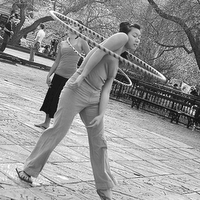
"I'm Dr. Robertson, and I'd like to teach you to hula hoop."

"Hoop Dreams- Physical Therapist … turns the hula hoop into fitness fun!" was the tag line of this news scoop I came across.

Even though this reminded me very much of a recent APTA marketing effort on the subject of gardening, rest assured this is a completely independent marketing venture.

For anyone who’s interested and lives near Washington Square Park in NYC, you can learn hula hoop from this recent NYU Graduate.

Which begs the question: Perhaps you do need a degree to teach hula hoop? Maybe that’s why I’m no good at it!

Labels: ,

Bed Rest is Bad!

How bad is bed rest for your back?

So bad that it can make a healthy back go bad!  Yet surprisingly, many general practitioners, and even the APTA’s own website prescribe exactly this for an onset of low back pain.

The study I’m linking to had healthy subjects spend weeks in bed.  After only 14 days, these otherwise healthy people had serious muscle deficiencies consistent with what is seen with back pain.  Keep those backs moving!

Labels: ,

Some medical exam comedy

An entertaining article in Slate magazine by Emily Yoffe, describes her experiences as a "standardized patient" for a group of Georgetown medical students conducting their first physical exam. Yoffe is well known for immersing herself into the issues she is covering, having previously entered the Mrs. America pageant as part of her coverage of the event. This time, she may have been in for a little more than she expected:

"Then he stood in front of me, looked at my gown like a colonel contemplating an incursion, and struck. He peeled off the top of the gown, dropping it into my lap, slipped the bra off my shoulder, and left me hanging while he protractedly listened to my heart."

This story is good comedy and speaks to both patients, and anyone who has ever had to learn how to perform a physical exam.

Labels:

"Every American is our patient…" Really?!!!

Or, I could have entitled this blog post: 

I went to school for a lot of years, got a doctorate degree, learned your anatomy inside and out and for that, I can tell you "Go out and play an hour a day."

It just seemed a little wordy.

These were the words of Rear Admiral Penelope Slade Royall, PT, MSW, as part of her keynote address Wednesday night at PT 2007, the annual conference of the APTA.  The headline of the speech was her "telling the considerable crowd that physical therapists are public health’s "first responders" for fitness."  Royall is the US Deputy Assistant Secretary for Health in the US Department of  Health and Human Services.

Well, is EVERY American our patient?  Is physical fitness our specialty?  Will Physical Therapists speaking as one voice about physical activity guidelines really help our profession and our patients?  I’m not so sure.

Or, is the ideal set forth by the Evidence in Motion working group, "that to improve our caliber as a profession, we have to shrink our role and be identified as experts in neuromusculoskeletal medicine" one that will help our profession and our patients?

Reading headlines such as "PTs: First Responders to Physical Fitness" seems to me to be suggesting our role to Americans is really one of a personal trainer.  Personal trainers do physical fitness better than Physical Therapists.  Perhaps this is because they specialize in it.

This goes back to an old question of strategy:  Should one try to do everything well, or should one do just a few things expertly?

You know, thinking more about the contents of the keynote address, I really feel like Royall is speaking about Physical Therapists in a light that will further her own agenda (and here) rather than our profession’s agenda.  I would do the same in her position; so would most.  If a government representative like Royall views Physical Therapists as Physical Fitness Responders, then what are we really?

This post is more questions than answers.  This is deliberate, as I think a public debate about how PT’s are marketing their profession is required.  We should all spend some time asking ourselves some questions about this issue.

Labels: , ,

How do you get your evidence?

I am employed by an academic institution with a fine health science library. I belong to several sections of the APTA as well as the AAOMPT. Through these affiliations I am able to get my hands on quite a few journals and read full text articles when I like.

I was thinking the other day, about how many allied health professionals do not have access to such a library of content. This would include those working in private practice, non-academic hospitals, rehab centers, local school systems, etc. How do these folks get their dose of evidence? How difficult is it to get access to an important new article?

There is PEDRO, and the Cochrane Database, and the APTA resources such as Open Door, but these are far reduced from what I use. They also suffer from lack of use among therapists. A scattering of journals offer free text, but usually there is a time delay or restriction with this. A service like InfoPOEMs is kind of expensive and not rehab focused even if it is useful in theory.

A colleague recently left the hospital system that I’m in and now works at a corporately owned outpatient clinic. She has no access to journals.

Barriers lead to inactivity. Inactivity leads to the failure of the principles surrounding Evidence-Based Practice. How much of a professional duty is it for health care providers to pay their own $$ for access to evidence? How much of that burden should fall on the employer?

I will assume that a majority of the Physical Therapy work force is in practice settings with limited access to rehab/ortho journals. Does this mean that the majority of the profession does not keep up with new evidence? Regardless of that being true or not, I think these barriers need to come down somehow.

Any thoughts on access to literature among Physical Therapists?

Image: Arnold Bernhard Library, Quinnipiac UniversityHamden, Connecticut

Labels: ,

Spotted Owls, Take II

Famously in 1990, the Spotted Owl was declared an endangered species. It is generally assumed by some that this ruling and the subsequent ban on logging old growth public forests contributed to a decline of the entire northwest logging industry.

Last week, the U.S. Fish and Wildlife Service proposed to reduce the size of protected land by 22%. While the issue of opening ANY old growth forest up to logging bothers me, I’m not an expert. I know nothing about forests, logging, or owl habitat and so my opinion matters little. Here is a commentary of the issue that I liked.
But, this follow-up article, which outlines the questionably close relationship between Fish and Wildlife Officials and logging powerhouse Weyerhaeuser, made me angry enough to blog about it.
Apparently, the US officials let the logging company edit their proposal to reduce the ban on logging. Why didn’t they let the environmental groups edit the proposal as well? This quote from the article sums up the way that Weyerhaeuser conducts business:
"In the mid-1990s, Weyerhaeuser told federal officials it would create a "habitat conservation plan" to guide its Southwest Washington logging. Because of that, the state did not take special efforts to protect owls there, as it did elsewhere. But Weyerhaeuser never produced the promised plan."
As annoying as environmental groups can be sometimes, I think instances like this are exactly what they exist for. Ironically, the Spotted Owl might be on the verge of extinction, but a large part of that has to do with the fact that it is "hybridizing" with the very closely related and thriving Barred Owls. In other words, perhaps the logging isn’t the biggest threat to the species. Maybe nature is.
"The barred owl either eats [spotted owls], kicks them out of their habitat, or mates with them—and sometimes the offspring are fertile…"
 
Sparred Owls???

6/27/07:  Update:  Today’s CSM has a great article on this issue.  They obviously read my blog and considered it big news!

Labels: ,

What should we do with this window?

Rockefeller Plaza is some pretty valuable real estate. It looks like the APTA has got their hands on 115 square feet of it for the month of June in the form of a picture window. The window’s content is about Physical Therapists’ ability to help prevent diabetes:

"The oversized panels also explain how physical therapists can help people with type 2 diabetes by designing a safe and thorough physical activity regimen that meets individual needs. The centerpiece of the window display is a life-sized female mannequin, who demonstrates the proper "fit walking," technique. She is standing in front of a video illustrating the various ways people incorporate physical activity into their daily lives."

Fit Walking Technique??? Well, at least my membership dues didn’t pay for this. The window space was donated by Executive Health Exams International. Which is also interesting.

In other news, an angry mob of internists was seen accosting a group of APTA members near Alexandria, VA. As the attack was taking place, the internists could be heard chanting, "You’re experts in muscles and bones, leave the diabetes to us…"

Labels: ,

Unfortunate Weekend News Roundup

Browsing through my various news feeds this weekend lead me to the following two instances of Physical Therapists making news headlines:


This is about a new facility in Summit County, CO now offering Primal Reflex Release Technique. Click here for a somewhat disturbing video and an opportunity to sign up for a home study course in this technique.

Three individuals, including two Physical Therapists, were arrested and charged with health care fraud, allegedly billing for services not performed and billing for Physical Therapy performed by a massage therapist. At least the FBI knows all about our profession. That’s good, right?

How are we doing policing ourselves as a profession? When instances like these happen, the concept of professional autonomy is undermined as the trust we demand from society is eroded. These are fairly extreme instances (and in one case, criminal,) but how do we do in situations that are not so obviously concerning? Such as: Treating too many people simultaneously to bolster a bottom line, over or misuse of modalities, not keeping up with current evidence on a particular condition or patient type? Do Physical Therapists, or any health care profession for that matter, really have a good system in place to help police the rank and file?

Anyway, perhaps that is too much philosophy. All I really want is some Good Press!

Labels: , ,