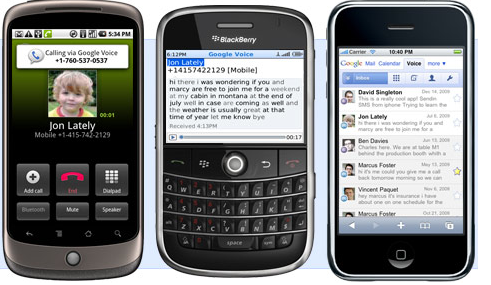


Smart phone “use” by physicians. What do the numbers really mean?

A recent article entitled “Why industry surveys on physician adoption of smart phones could be overestimating reality”at iMedicalApps [Mobile Medical App Reviews & Commentary – A publication by medical professionals] explored what recent market research really means…

It has been cited in market research that 72% to 94% of physicians are using smart phones in clinical practice (Questions: How are they using them? And, how often?).  Josh Herigon, MPH  a second year medical student and blogger at Number Needed to Treat comments:

“Although these studies show a high degree of smartphone adoption among physicians, these results should be interpreted cautiously. These firms provide few details on how they actually conducted these studies. A major hurdle to conducting such research is sampling bias. This can occur in survey research when researchers get a low response rate (i.e.—researchers approach a large number of individuals to fill out a survey but few actually fill it out).”

A little bird told me that a PTJ internal study revealed that no more than 50% of the physical therapists they sampled used smart phones. And, while the percentage of professionals who have and use smart phones is interesting data, I think there is a bigger question to consider. How many physicians, physical therapists, and other healthcare providers who own smart phones are using them routinely and effectively in clinical practice?

Owning a smart phone and leveraging its capabilities during clinical practice are two vastly different things. I am an avid smart phone owner and user, but to be honest, I rarely use my phone in clinical practice. I actually use it most while practicing within the in-patient hospital setting to look up medications, abbreviations, surgeries, and specific diagnoses. But, that is only when I am not near, or logged into, a computer. Admittedly, in the outpatient setting I grossly underuse the capabilities of my phone.

Why are we still giving out paper copies of exercises and patient education? I believe the opportunities for leveraging this technology for clinical support, aiding in clinical decision making, and pt. education are infinite. In my opinion, routine use could actually markedly increase efficiency and quality of care especially in physical therapy. Patient’s use and love their smart phone, so why aren’t we interfacing with them using technology? [Yes, I understand the potential HIPPA considerations and that is not the point of this post]

Do you think it would be possible to run a private practice and physical therapy LLC strictly from a smart phone. If not, why not? Paper is messy and overated anyway…

Do you have a smart phone? If so, how are you using your smart phone in clinical practice? Do you use specific applications? Any ideas for how we can better utilize this technology as we move forward?

Considering making the switch to a smart phone? Check out this article targeted towards medical professionals: iPhone, Blackberry, or Android?

Some Friday Humor

The Onion is always good for a laugh!

Labels:

God Bless You, Mr. Vonnegut…


Kurt Vonnegut has died. He split his head in a fall and last night he died. And so it goes…

“When the last living thing

has died on account of us,

how poetical it would be

if Earth could say,

in a voice floating up

perhaps

from the floor

of the Grand Canyon,

“It is done.”

People did not like it here.”

Labels:

Patient Conversation of the Week

Excerpts from especially memorable patient encounters:

ME: So what made your back pain worse?

Patient: The Physical Therapy made is worse.

ME: Well, what did you do in PT?

Patient: What they told me to do.

ME: What did they tell you to do?

Patient: Things that hurt.

Excellent!

Labels:

Here Comes Google!

I was interested to see this morning’s post on the Official Google Blog: “How do you know you’re getting the best care possible?”
Google asks an open question about finding quality healthcare information. The post has serious implications about the future of how patients can learn about their conditions, doctors, and choices.
A while back I also observed a post on health information and evidence from Google. It is clear they are making a plan to be a source of quality health information. I suspect Google will probably change the way patients and doctors interact if able to “smarten-up” healthcare consumers. They want your feedback, so go drop them a line!

Labels: , ,

Why Do They Smoke?

I started thinking about this the other day while hanging out with friends…who were smoking. I was wondering why so many young people I know smoke in light of such very strong evidence not to. I put the thought away, until a very nice conversation I had today motivated me to write about it.
This report confirms my personal observation, that even while overall smoking rates decline, the rate of smoking among young adults is climbing! I just can’t understand.
I guess I will not spend too much time trying to figure out this complex problem, but my message today will be:
In order to change behavior, sometimes more than just good evidence is needed. Often it takes a driving, deeply motivating issue to enact that change.

Labels: ,

Drug Companies Eat Zebras?

“Drug companies are like lions,” Dr. Grimm said of his sponsored talks. “For lions, it’s their nature to kill zebras and eat them. For drug companies, it’s their nature to make money. They’re not really trying to improve anybody’s health except if it makes them money.”

Those of you who regularly read my blog and know me at all, are probably very aware of my distaste for pharmaceutical companies and their perpetual courtship of physicians.

Here is an article that has some solid numbers behind it, including a couple instances of doctors receiving money from a drug company AND making guidelines for other doctors to follow that includes the drug they are being paid to promote!

Did you hear that? A doctor may make guidelines for how much and often a kidney patient receives a cholesterol medication even while being paid by the manufacturer of that medication. Outrageous!

How, in light of this conflict of interest, are we to trust any formal guidelines at all?

Does anyone else see a problem with this? This guy from Harvard does:

“When honest human beings have a vested stake in seeing the world in a particular way, they’re incapable of objectivity and independence,” said Max H. Bazerman, a professor at Harvard Business School. “A doctor who represents a pharmaceutical company will tend to see the data in a slightly more positive light and as a result will overprescribe that company’s drugs.”

This problem seems slightly more important than local North Augusta doctors, DEMANDING lunch for their entire office in order to speak to me…acting as the drug companies have conditioned them to.

Credits: The picture was observed here, in a nice lecture on the physiology of a lion-zebra chase!

Labels: , ,

The Evolution of Rehabilitation

A series of blog posts led me to MedInnovationBlog, where I read a post: On Physical Therapists and Keeping Patients Moving.

That was nice to see and read about. Then came the comments. Physiatrists, upset that one could write about the profession of Physical Therapy and not give them credit. The blog author seemed pathetically apologetic in his response, and even went so far as to quickly credit Physiatrists for helping train Physical Therapists. Some clarification is needed.

The history of both Physiatry and Physical Therapy have very closely knit roots. In reviewing several sources of historical information on these professions, I find it interesting that neither mentions the other. Odd, because careful reading of these histories suggest each profession arose out of the same need and then developed independently.

Both professions start out with claiming roots to Hippocrates and the such….but let’s start at a more realistic date: World War I and 1917.

The Army, trying to deal with many injured soldiers, commissioned two physicians to create the Division of Physical Reconstruction upon recommendation from the Division of Orthopedic Surgery. The two physicians, Frank Granger, MD, and Joel Goldthwait, MD, signed on two Reconstruction Aides (read: Physical Therapists) who had already been trained and were helping patients with polio in Europe and the U.S. with rehabilitative modalities. They were Marguerite Sanderson and Mary McMillan. All four of these individuals eventually became influential in the founding and growth of the two professions in question. Each profession initially faced a struggle to become an accepted part of the current medical establishment.

Today, the two professions are largely separate, with unique educational programs and autonomy. The growing knowledge base of one is interdependent upon the other and each must yield respect accordingly. In my daily routine, I use the professional journals of each equally.

There is, however, one significant change upon us. For the first time, Physical Therapists are not dependent upon physicians for prescriptions, diagnoses, or treatment plans and are being educated to the doctorate level. It will be interesting to see how the relationship between these two mutually beneficial professions will continue to evolve in light of these changes.

Labels:

Google Searching for Back Pain

One of the things I think that Physical Therapists treat very well is the all inclusive “back pain” complaint. I’m quite proud of not only my personal skills, but the very helpful recent advances in research to support our practices. I wondered if the general public had any idea…
I was playing with the new, Google Trends (above), and queried: physical therapy (light blue), back pain (red), orthopedic (yellow), chiropractor (green), and manual therapy (the spec of blue on the bottom right). I wish manual therapy was more popular. So I continued…
I decided to search Google for “Physical Therapy” and “back pain.”
I was disappointed that the entire first page of results had exactly ZERO sources of information written by Physical Therapists or anything closely relating best/current evidence and no links to anything manual therapy-related.
I then searched a Google Custom search engine for the same term. The results were far better from a scientific perspective, but really not useful at all to a consumer. I wish the result of the search was somewhere in between the two.
I’m not sure what all this means, but I think it’s a marketing need and an opportunity.

Labels: , ,

Calculator Day

A pound of body fat (see image) equates to approximately 3500 calories. So a calorie deficit of 500 calories (meaning that you burn 500 calories more than you eat each day) you would lose approximately one pound per week:

500 x 7 = 3,500
A calorie deficit of 1000 calories would mean that you’d lose approximately two pounds per week. That’s a good number to remember, because two pounds a week is commonly accepted as the maximum rate of weight loss that is healthy.
Here are some exercise-related calorie calculators to experiment with:
Basal Metabolic Rate
Activity Calculator taking into account body weight
Another one, with adjustable definitions.
A very cool, simple Daily Expenditure Estimator
A Disease Risk Calculator from Harvard University. (very cool)

Body Mass Index Calculator (now losing respect as a measure of obesity)

Labels: , ,

Next Page →